Travel Guidebest places to stay in CyprusCyprus travel guideCyprus villas
Best Places to Stay in Cyprus for Sightseeing
IN
Irena Nieslony1 July 2026 · 10 min read
Cyprus is a fascinating island of rich history, stunning beaches with turquoise water, delicious food and wine, and natural wonders such as mountains and gorges.
If you want to spend all or part of your holiday sightseeing, plan on at least a week — and you still probably will not see everything, which is why so many people come back.
To give yourself the freedom to travel when you want, you are better off in a luxury villa in Cyprus than in a hotel, where you are tied to set meal times. Cyprus villas have fully equipped kitchens, so you can eat as early or as late as you like, and put together a picnic if you are heading out for the day.
This Cyprus travel guide will help you decide which area to base yourself in, according to your interests. Maybe you want to visit archaeological sites and museums, perhaps you are drawn to churches and monasteries, or your interests lie in hiking and exploring the little villages of the Troodos Mountains. These are the best places to stay in Cyprus for sightseeing.
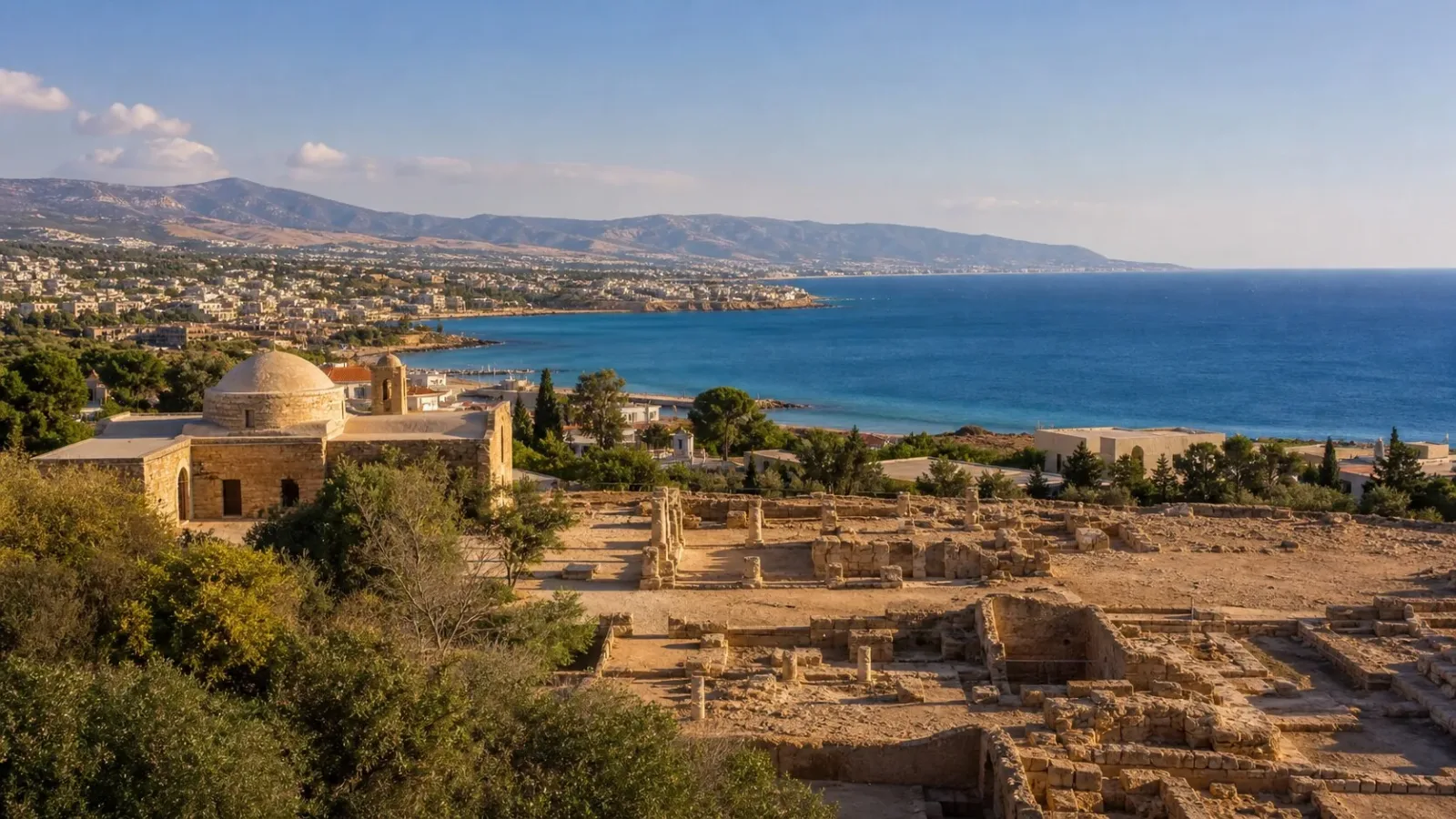
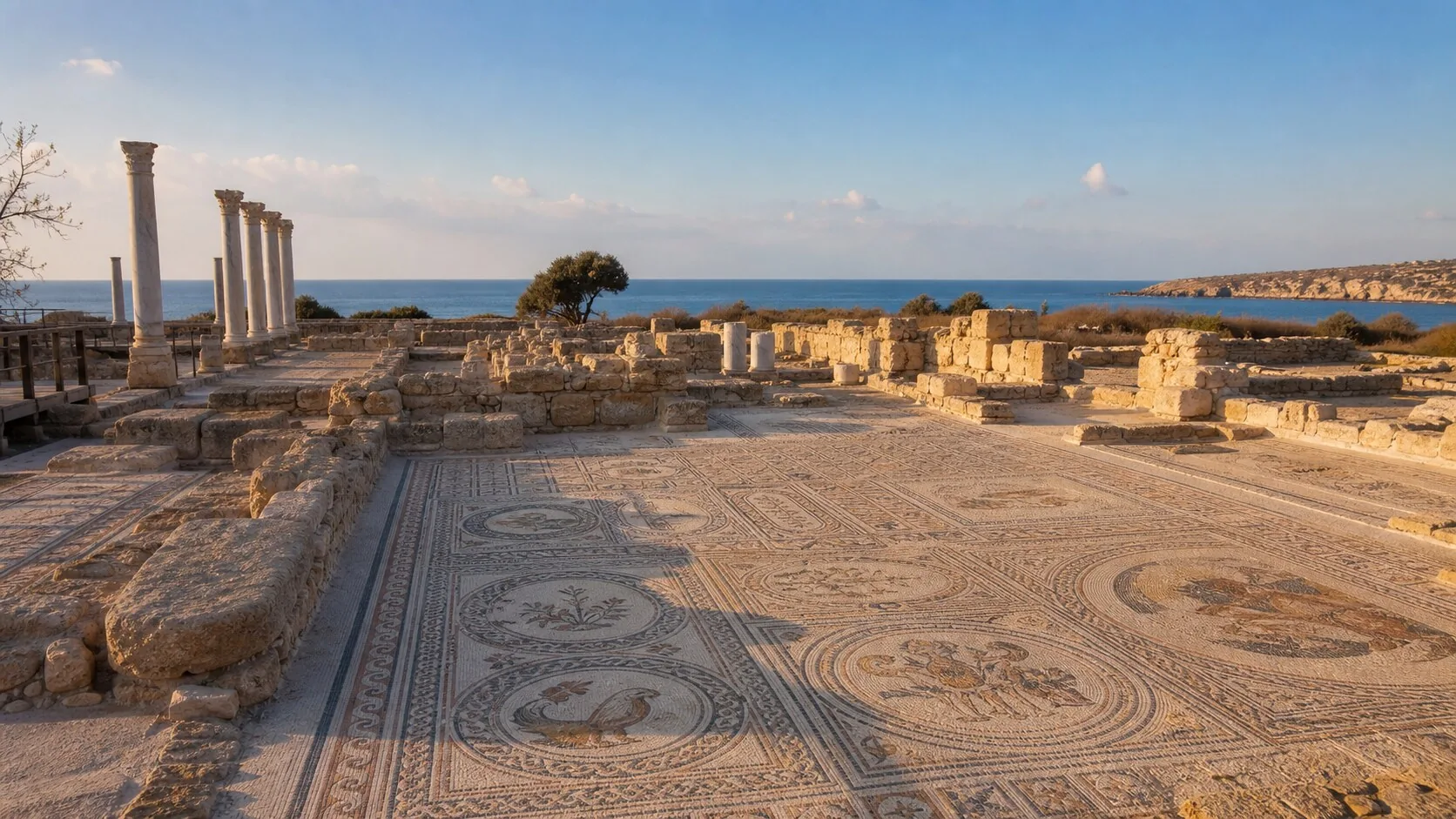
Paphos: Best for Archaeology and Coastal SightseeingRoman ruins at Paphos Archaeological Park in Cyprus
Roman ruins at Paphos Archaeological Park in Cyprus
Paphos sits in the southwest of the island and is one of the best places to stay if you are interested in archaeology.
Paphos Archaeological Park
In Kato Paphos, which translates as Lower Paphos, you will find the Paphos Archaeological Park, where you can see the well-preserved ruins of ancient Nea Paphos, capital of the island between the 2nd century BC and the 4th century AD.
The site holds buildings and monuments dating from the 4th century AD to the Middle Ages. The park is especially renowned for four Roman villas with beautifully preserved mosaic floors depicting scenes from Greek mythology. Other highlights include the Asklepieion, a temple dedicated to Asklepios, god of medicine, and the Odeon, which was used for musical performances. There is also the Agora, the market that was the centre of daily life in ancient times, where people discussed legal matters, did business and met friends. You will find the 40 columns known as Saranda Kolones, the remains of an early Christian basilica, Limeniotissa, and the famous Tombs of the Kings — although no kings are buried there, but aristocrats, prominent citizens and high-ranking government officials. The park is open all year round.
Museums and Churches in Paphos
Paphos also has an archaeological museum with regional finds, including pieces from the Archaeological Park.
If you are interested in churches, visit the Church of Saint Nicholas in town, a Greek Orthodox church dedicated to the patron saint of sailors, which is still in use. It is also a fantastic place to watch the sunset.
Avakas Gorge and the Aphrodite Trail
If your sightseeing leans towards the natural world, you can hike the 7-mile (11.6 km) Avakas Gorge in the Paphos province. There is amazing flora to be seen, such as oleander and pistachio, as well as porcupines, hares and lizards. The hike is moderately challenging, partly because you have to clamber over rocks inside the gorge. When you emerge, though, you are on a grassy plain with magnificent views. Do not forget your camera.
Between Paphos and Limassol there is the Aphrodite Nature Trail, a circular route of 4.6 miles (7.5 km). It is not too difficult, but there is some uphill walking. It is a mythical trail following in the steps of Aphrodite, starting at the Baths of Aphrodite and passing the oldest living oak tree, where she would sit after her bath.
Aphrodite’s Rock
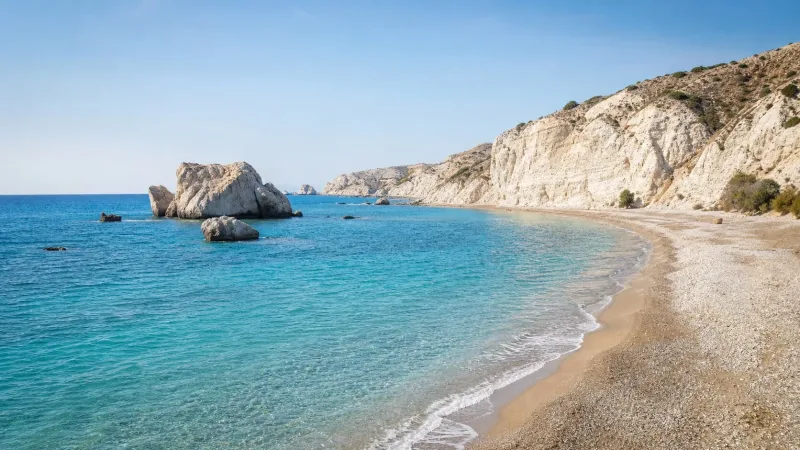
Also on the southwest coast between Paphos and Limassol is Aphrodite’s Rock, a stunning sea stack celebrated as the mythological birthplace of Aphrodite, the Greek goddess of love and beauty. Legend has it that she rose from the sea foam at the rock and was carried ashore in a giant shell. You can view it from the nearby beach, reached by a pedestrian underpass from the main road. Local folklore says that if you swim around the rock three times you will be blessed with eternal youth, beauty and love — but the seas there are rough, so it is not advisable, and climbing the rock is not permitted.
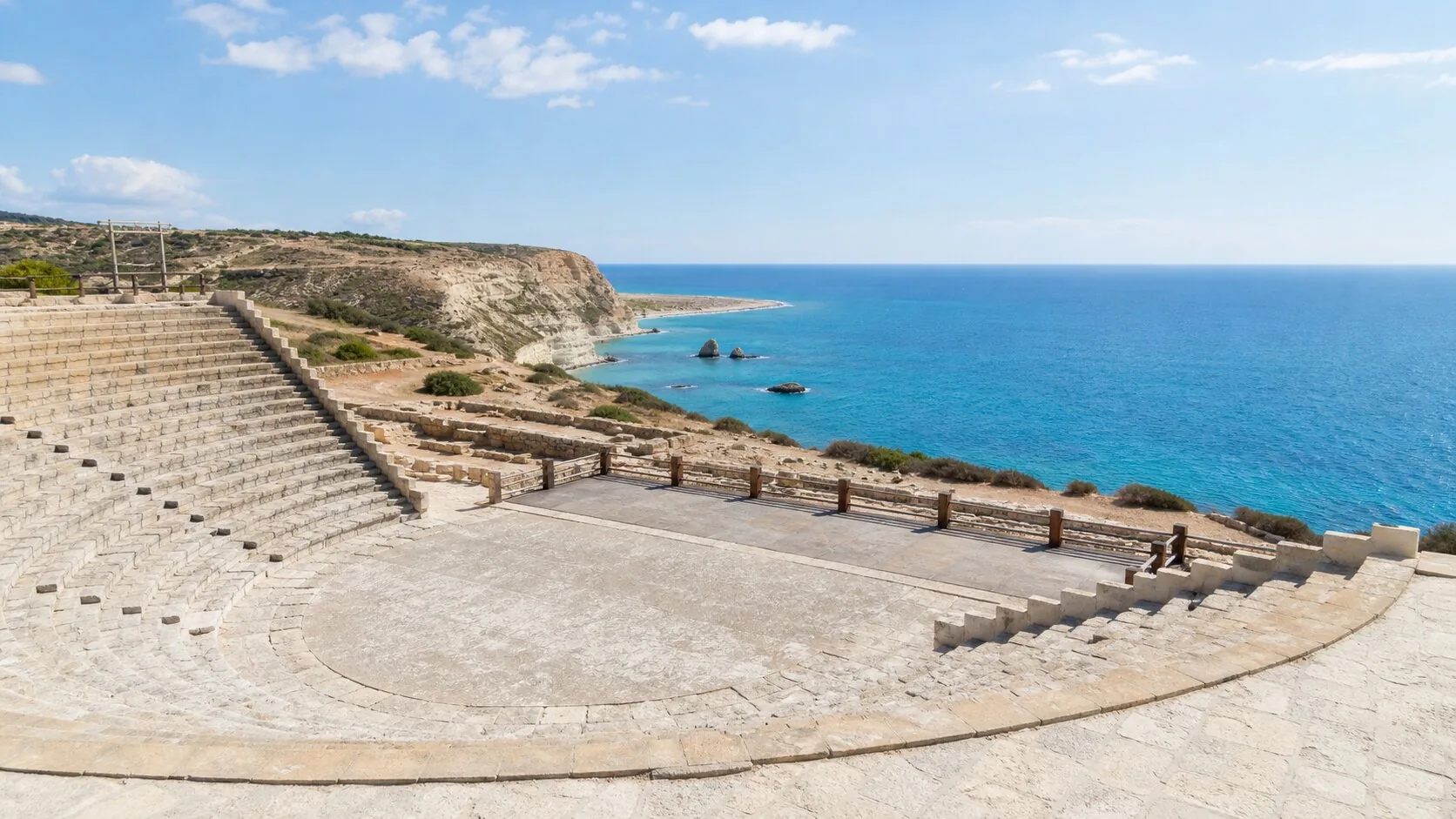
Limassol: Best for Ancient Kourion and MuseumsAncient Kourion amphitheatre overlooking the Mediterranean near Limassol
Ancient Kourion amphitheatre overlooking the Mediterranean near Limassol
The Limassol region is another area that attracts history buffs. Perched on a coastal cliff close to the town is Ancient Kourion, a spectacular archaeological site overlooking Episkopi Bay. The highlight is the Greco-Roman theatre built in the 2nd century BC, still used today for musical and theatre performances.
There are Roman villas on the site, such as the House of Eustolios, which belonged to a wealthy Roman and was later converted into a public recreation centre, with a bathing complex and stunning mosaic floors. The House of the Gladiators has mosaics in the courtyard depicting gladiators fighting, while the mosaics in the House of Achilles show the moment Achilles’ identity was revealed. There is an early Christian basilica from the 5th century, the Roman Agora, public baths and a sanctuary dedicated to wood nymphs. Close by are the stadium and the Sanctuary of Apollo Hylates, where the remains of a running track can still be seen.
Limassol also has an archaeological museum showcasing artefacts from the region, from the Neolithic Age through to the Roman period. There is a Historic and Classic Motor Museum in town, and the Cyprus Folk Art Museum displays Cypriot crafts and ceramics.
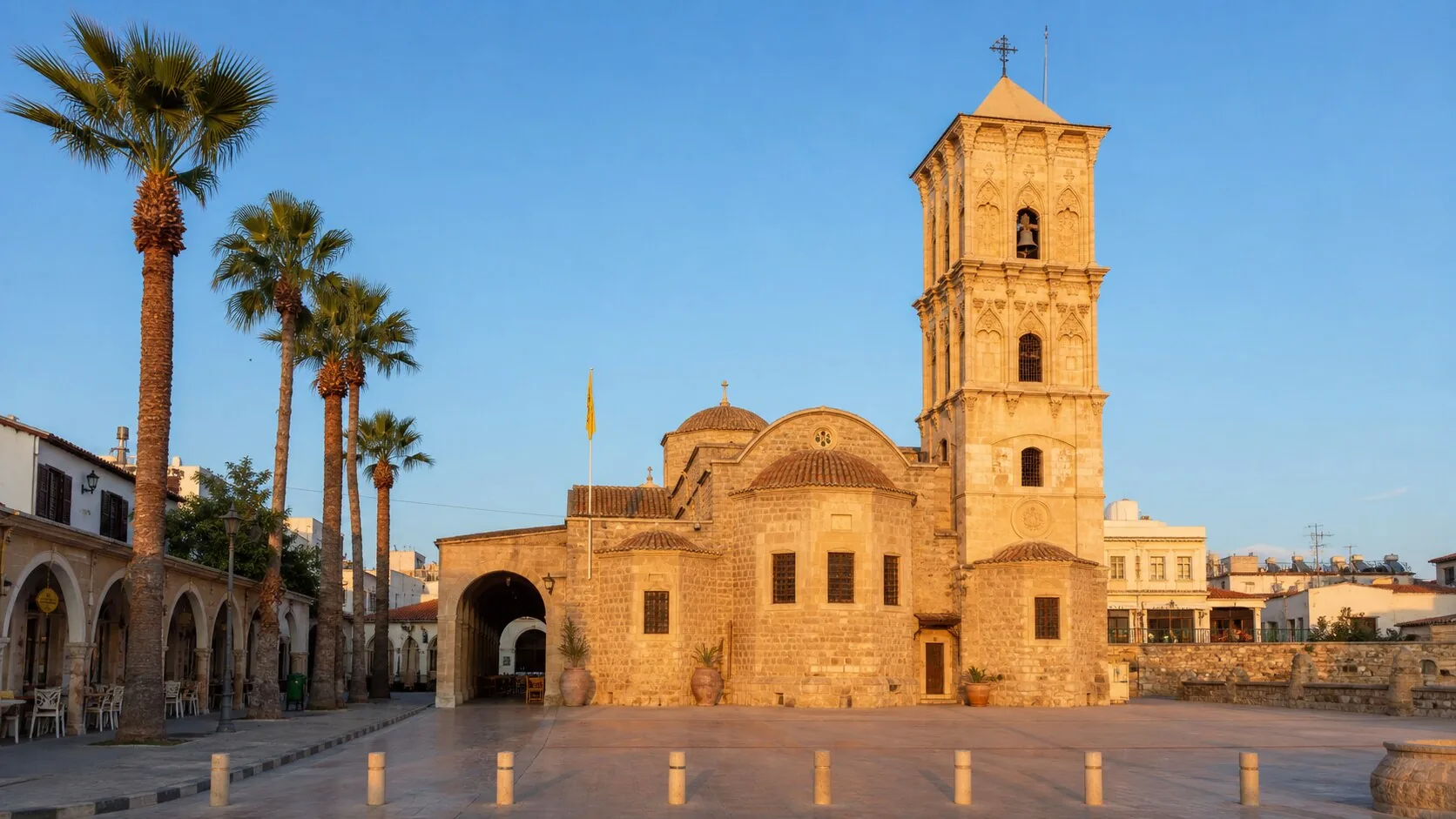
Larnaca: Best for Churches, Museums and Nicosia Day TripsChurch of Saint Lazarus in historic Larnaca, Cyprus
Church of Saint Lazarus in historic Larnaca, Cyprus
Many people fly into Larnaca for the beaches and the party life in Ayia Napa, but there is plenty for sightseers in Larnaca itself. The Larnaca district is also a good base if you want to explore the capital, Nicosia, roughly 50 miles (80.5 km) away.
Museums and Churches in Larnaca
The archaeological museum showcases 4,000 years of the region’s history, while the Pierides Museum, the oldest private museum on the island, holds artefacts and pottery dating back as far as 5,000 years.
Saint Lazarus Church, built in the 9th century, is an impressive building lying over the tomb of Saint Lazarus. It houses some stunning paintings and a Byzantine museum.
Next to the promenade, with fantastic views of both the city and the sea, is a fort built in the 17th century by the Ottomans during their occupation of Cyprus. It hosts the Medieval Museum, and across the road is the Grand Mosque.
Larnaca Salt Lake
If you are interested in birds, head to Salt Lake just outside the city, well known for its migratory visitors. Between November and March you will see thousands of flamingos. In summer the lake evaporates and leaves a white layer of glittering salt. Close by is the Hala Sultan Tekke, a mosque built in 1816.
A Day Trip to Nicosia
Nicosia is a fascinating city, divided down the middle into Greek Cypriot and Turkish Cypriot halves. If you want to cross to the Turkish side, remember to take your passport and only cross at marked checkpoints.
On the Greek side you can visit the Cyprus Museum, the largest and oldest archaeological museum in the country, home to the biggest collection of Cypriot antiquities from Neolithic times to the Roman Age. The A.G. Leventis Gallery holds a large collection of Greek and European paintings alongside Cypriot art, while the Leventis Museum tells the story of Nicosia from 3000 BC to the present day.
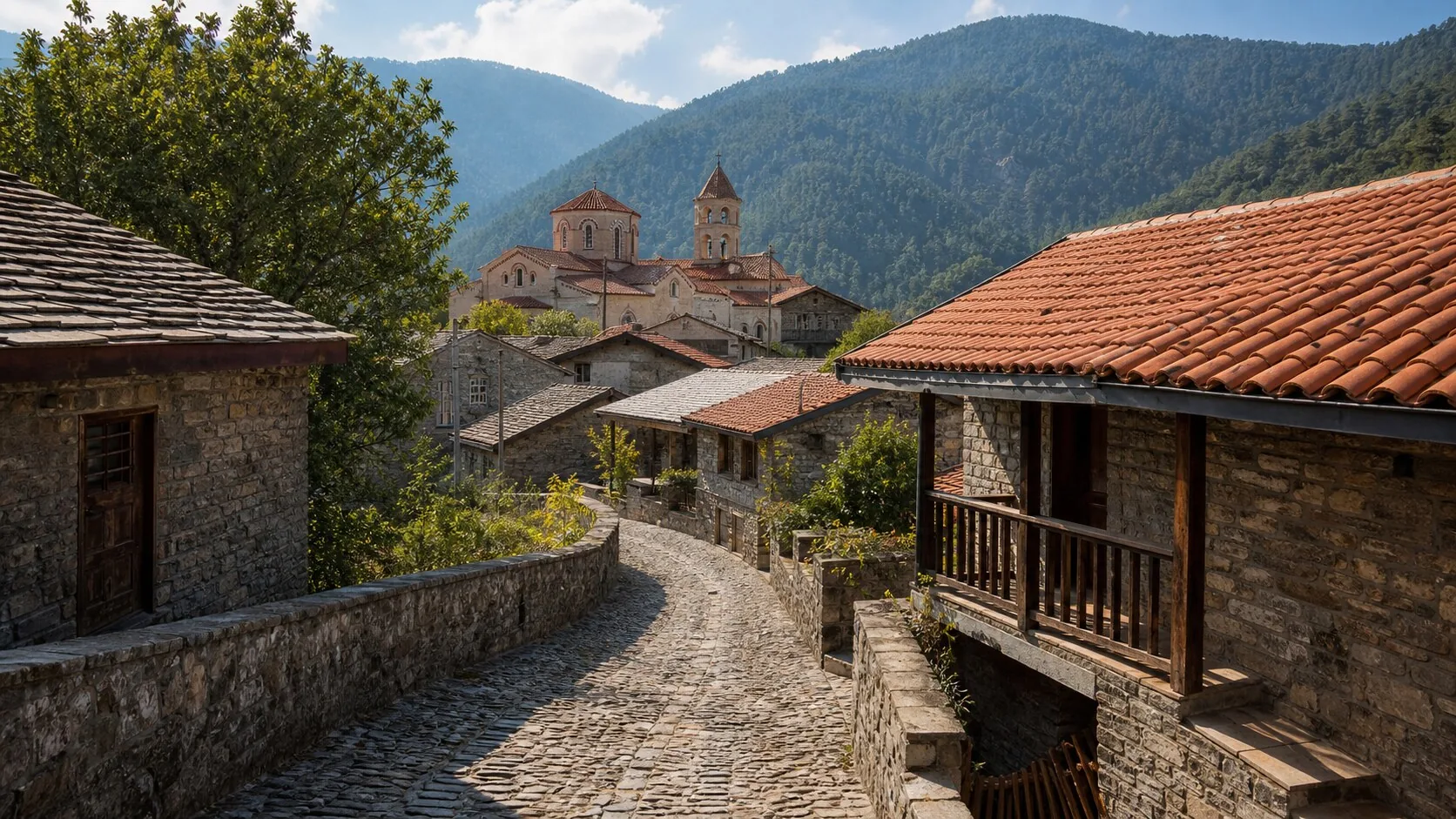
The Troodos Mountains: Best for Villages and MonasteriesTraditional stone village in the Troodos Mountains, Cyprus
Traditional stone village in the Troodos Mountains, Cyprus
The Troodos Mountains are a wonderful place for exploring traditional villages, hiking and visiting monasteries. They are easiest to reach if you are staying in either the Limassol or Paphos region: Limassol is almost 25 miles (40 km) from the start of the mountains, while Paphos is 43.5 miles (70 km) away.
Kalopanayiotis is a particularly interesting village. It spreads across a hillside with spectacular mountain views from the top and a peaceful river at the bottom crossed by a medieval bridge. There are natural sulphur springs by the bridge, still used for their healing properties. The village is also home to the UNESCO-listed Saint John Lampadistis Monastery, a must-visit for its stunning Byzantine frescoes.
In the northwestern part of the range you will find Kykkos Monastery, one of the richest on the island. The church and grounds are beautiful, and the monastery museum holds an impressive collection of religious art, manuscripts and antiquities.
Omodos is a town with a bustling main square. Get lost in its labyrinth of cobbled streets and visit the Timios Stavros Monastery.
When Is the Best Time to Go Sightseeing in Cyprus?
The best time to go sightseeing in Cyprus is during the shoulder seasons of May to June and September to October, when it is not as hot as the peak months of July and August, when temperatures easily reach 35°C (95°F) or more.
Cyprus is a year-round destination, although some restaurants and bars in the resorts close over winter. Plenty stay open, and the temperature is pleasant, ranging from 16°C (60.8°F) to 20°C (68°F). As long as it does not rain, that is an ideal temperature for walking around archaeological sites.
Essential Tips for Sightseeing in Cyprus
Book early. If you are booking a luxury villa in Cyprus, book well ahead unless you are travelling in winter. For the shoulder seasons, book 6 to 10 months in advance; for a private villa in peak season, reserve a year before.
Use concierge services. Many holiday villas in Cyprus have a concierge who can share tips and book excursions and restaurants for you.
Visit archaeological sites early in the day. Except in winter, sites are best seen as early as possible. Most open at 8 a.m., so get there close to opening. Put on sunscreen, take water and pack snacks, especially if you have children.
FAQs About Sightseeing in Cyprus
Do I need a car to go sightseeing in Cyprus?
Yes. If you are staying in a Cyprus villa it is advisable to hire a car, as sightseeing will be far easier. There are buses, but routes are limited.
Is it better to stay in a hotel or in a Cyprus villa when sightseeing?
A villa gives you flexibility. You will not be tied to set meal times as in a hotel, and you can prepare picnics in your own kitchen to take with you on days out.
What is the average cost of a villa holiday in Cyprus?
Prices vary with size and location. You pay for the villa, not per head, so it works out cheaper than booking multiple hotel rooms — a considerable saving for a family or a large group. Expect to pay between £120 and £350 per night.
What does it cost to visit an archaeological site?
State-owned archaeological sites are very affordable, generally between €2.50 and €4.50 per person. Some museums are free.
Where do I fly to in Cyprus?
To explore the Paphos region, fly to Paphos Airport. For Limassol and the Troodos Mountains, you can fly to either Paphos or Larnaca. For Larnaca or Nicosia, fly to Larnaca.
Ready to Plan Your Cyprus Sightseeing Holiday?
If you are coming to Cyprus to discover its history, you will find archaeological sites, museums, churches and monasteries spread across the whole island. Choosing the right base makes all the difference, and this guide should help you settle on the area closest to the sights you most want to see. Browse the Bnbstay collection of Cypriot villas to rent and start planning.
Receive £100 towards your first luxury villa stay, alongside first access to new property launches and insider travel guides.
By subscribing, you agree to our Privacy Policy. Your £100 welcome credit is valid on new bookings with a minimum stay of 7 nights. Unsubscribe at any time.